

Introduction — Why 1045 Shaft Material Still Dominates (600+ words)
When procurement teams ask for "1045 shaft material" they usually mean two things: a material that can be reliably processed into a precision shaft, and a cost profile that fits volume manufacturing budgets. Over the past 20 years I’ve seen three consistent reasons engineers prefer 1045:
- Predictable mechanical properties after standard heat treatments, which help meet fatigue and strength specs without exotic alloys.
- Availability in multiple stock forms — hot‑rolled, cold‑drawn round, ground shafts, and forged blanks — which reduces lead times and machining scrap.
- Familiarity in heat‑treat and grinding shops; induction hardening or surface grinding programs for 1045 exist at thousands of suppliers, enabling low risk in scale up.
But the choice to specify 1045 is not automatic. It requires context. A 1045 shaft will perform well in applications with moderate torsional loads, repeated start/stop cycles and where surface hardening (induction) or case hardening can be applied. It is less suitable where high hardenability or deep case carburization is required — that’s when alloy steels like 4140 or case‑hardening grades such as 8620 become the right call.
From a procurement angle there are practical tradeoffs to be aware of. Round bar stock in 1045 is widely stocked in Asia and North America, but heat‑treat distortions are common if shafts are thin and long — pickers and buyers must account for straightening, finish grinding and QC. If you order forged 1045 blanks instead of cut bar, the initial cost may increase but machining time and scrap can drop. For medium‑volume OEM programs, the total landed cost often favors forged and finish‑machined shafts despite higher per‑piece purchase price.
A few operational cautions from the shopfloor:
- Heat treatment control matters. Dimensional drift after hardening is the most common root cause for rework and missed delivery dates.
- Surface condition is critical. Turned surface vs ground surface leads to different induction hardening outcomes and finished hardness profiles.
- Supply variability: unspecified surface condition (hot‑rolled vs cold‑drawn) can create surprises in machining allowances. Always lock the stock condition in the PO.
Finally, 1045 has a procurement advantage: traceability and material test reports (MTRs) are common. Most mills will provide chemical analysis and heat treatment records on request. For regulated industries you can combine 1045 with accepted process documentation (FMEA, PPAP, Cpk results) to satisfy auditors without resorting to stainless or Cr‑Mo alloys unless strictly required.
This guide is written to help you specify 1045 smartly — not to sell it blindly. Below are technical details, comparisons, shopfloor insights and a supplier checklist so you get parts that fit, perform and ship on schedule.
Industry pain points: what buyers get wrong about shafts
- Ordering "1045 bar" without stating surface finish, straightness and normalization state — produces mismatches in grind allowance and lead time.
- Under‑specifying heat treatment tolerances (hardness bands, depth) — leads to repeated hardening cycles and scrap.
- Ignoring logistics protection (VCI paper, oiling, boxing) — rust in transit is common for long sea shipments.
- Choosing 1045 for high fatigue components without fatigue testing — sometimes leads to premature failures where alloy steels would be safer.
Technical breakdown — chemistry, mechanical properties and heat treatment
Standard designation references: SAE/AISI 1045. Typical chemistry and mechanical ranges (practical shopfloor values — use MTRs for contract specs).
| Parameter | Typical Range / Notes |
|---|---|
| Chemistry (wt%) | C 0.43–0.50 / Mn 0.60–0.90 / Si 0.15–0.35 / P ≤0.04 / S ≤0.05 (mill tolerances apply) |
| Tensile strength | ~ 550–700 MPa (depends on condition — normalized vs quenched & tempered) |
| Yield strength | ~ 300–450 MPa (approximate ranges for typical heat treated states) |
| Hardness (HRC / HB) | Annealed ~179–220 HB; surface hardened shafts often 55–62 HRC at the case with core remaining tougher |
| Heat treatments | Normalize, quench & temper, induction hardening, surface grinding. Not ideal for deep nitriding without alloy additions. |
Practical note: if you need a deep hardened core or high hardenability through a 40+ mm diameter, specify an alloy steel (e.g., AISI 4140) or request a double‑shot induction program. For surface contact parts where only a wear surface is needed, induction hardening of 1045 is cost effective.
Product advantages & real limitations
- Cost‑effective bar and forged blanks availability worldwide.
- Good balance between strength and machinability for medium duty shafts.
- Compatible with standard heat treatment and grinding operations; many subcontractors have established process controls for 1045.
- Easy to weld and repair in field operations (with pre/post heat as needed).
- Poor deep hardenability — not ideal for heavy sections requiring uniform hardness.
- Surface corrosion protection required for marine or high‑humidity shipments.
- Fatigue performance can be sensitive to surface finish and residual stresses from heat treatment.
Material comparison — pragmatic choices for buyers
| Grade | When to pick | Typical tradeoff |
|---|---|---|
| 1045 | General shafts, moderate loads, induction hardening cases | Cheap and widely available; limited deep hardness |
| 1018 | Low cost, easy machining, low strength shafts | Better machinability but lower strength than 1045 |
| 4140 | High fatigue and impact resistance, deeper hardenability | Higher cost, more complex heat treatment control |
| 8620 | Case‑hardened gears and shafts requiring deep case | Used for carburizing; less core strength than alloy steels unless tempered |
| Stainless (e.g., 304/316) | Corrosion environments — not recommended for wear surfaces unless coated | Poor wear resistance vs hardened carbon steels; higher cost |
Specification & tolerance table — drafting tips for POs
Below is a practical checklist to include in your purchase order or drawing to avoid ambiguity.
| Item | Example requirement |
|---|---|
| Material grade | SAE/AISI 1045, mill MTR required (chemical & mechanical) |
| Stock condition | Cold‑drawn round bar, ground OD tolerance ±0.05 mm |
| Heat treatment | Normalize, temper to 50–55 HRC surface after induction, core hardness max HRC 30 (as required) |
| Surface finish | Ra ≤0.8 μm after final machining / grinding |
| Straightness & runout | Total indicator reading (TIR) ≤0.05 mm over specified length |
| Packing | VCI paper + rust preventive oil + palletized crate for sea shipment |
splined shaft manufacturer industrial shaft manufacturers a shaft
Applications, machining & installation considerations
Typical applications: transmission shafts, sprocket shafts, pump shafts, axles for light machinery, couplings and studs. Manufacturing insights:
- Pre‑turn oversize allowance: when ordering hot‑rolled bar specify extra allowance for finish grinding—commonly +0.5–1.0 mm depending on diameter and heat treatment plan.
- Balancing: dynamic balancing after final machining reduces vibration risk — specify balancing grade based on RPM and application (G2.5/G6.3 when necessary).
- Keyways & splines: broaching after heat treatment is possible but harder and more expensive; consider finish machining before induction hardening to reduce machining force.
- Assembly notes: light press fits vs interference fits require specified surface finish and lubrication to avoid galling on carbon steel shafts.
Installation caution: induction‑hardened surfaces are brittle near the case—avoid over‑tightening set screws or using improper tools during assembly.
Logistics, packing, lead time & export tips
- Lead time: standard bar stock — 1–3 weeks depending on size and country of origin. Forged blanks or finish machined shafts — 4–8 weeks typical for offshore suppliers (confirm via PO).
- Packing: recommend VCI paper + light oiling + plastic wrap + wooden crate for sea shipments. For high humidity routes ask for desiccant packets.
- Container loading: for long shafts use angle‑brackets and cross strapping to prevent sagging. Distribute weight across pallets to avoid overloading corner boards.
- Customs & MTRs: request certified MTRs and mill heat numbers on packing list to avoid delays in inspection at destination ports.
Supplier evaluation checklist & OEM/ODM options
- Ask for MTRs linked to lot numbers and the heat number stamped on parts.
- Request process flowchart: from bar/forging to heat treatment, grinding, final inspection.
- Check capability: induction hardening equipment, CNC finish grinding, dynamic balancing, NDT (mag particle or UT when required).
- OEM/ODM: if you need drawing‑to‑part services, confirm tooling ownership, sample turnaround and IP terms before tooling begins.
Certifications & factory capability snapshot

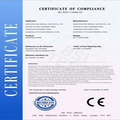

Requested documents: MTR, heat treatment report, hardness map, dimensional inspection report (CMM print) and packing list. These documents reduce commercial risk on arrival and speed customs release.
Customer reviews — real procurement scenarios (3–6 realistic reviews)
We switched our medium‑duty pump shafts from 4140 to 1045 ground bar with induction hardening on the journal. Result: similar life at lower price and simpler QC. Manufacturer supplied full MTRs and hardness profiles — good transparency.
Ordering forged 1045 blanks reduced cycle time in our CNC line. One lesson: insist on pre‑hardening straightness limits — saved one rework batch.
Good supplier communication about packing (VCI + oil) avoided rust after sea transit. Delivered shafts arrived ready for assembly after light finish grinding.
FAQ — targeted technical & procurement answers
Q: Is 1045 suitable for high RPM shafts?
A: Yes for moderate RPM if dynamically balanced and properly finish‑ground; consider surface hardening and vibration analysis for higher RPM designs.
Q: Can 1045 be induction hardened through a keyway?
A: You can induction harden sections with keyways but planning is needed — often keyways are machined after hardening or masked properly to avoid cracking.
Q: What is a typical lead time for customised shafts?
A: For small batches (100–1,000 pcs) expect 4–8 weeks if forging and heat treatment are required; simple bar‑to‑machined parts can be 2–4 weeks. Ask suppliers for a mill‑to‑shipment timeline in the RFQ.
Q: Do you supply OEM/ODM services?
A: Yes — we offer tooling, forging, finishing, inspection and packaging programs. Tooling ownership and MOQ terms are agreed up front.
Related research & industry viewpoints (selected references)
For manufacturing process optimization and production reliability we often consult cross‑discipline research. Selected viewpoints:
- Research and industry analyses on mold, material characterisation and process simulation highlight how accurate input data reduces defects — relevant when coordinating heat treatment and process simulation workflows. See: MDPI — How Method Matters: Material Characterisation Techniques.
- Work on reducing waste in precision process chains offers practical lessons transferable to tooling and forging optimization in shaft production. See: Fraunhofer Research — Reducing Waste in Process Chains.
- Discussions about advanced process control and AI‑based optimization are becoming useful for predictive heat treatment and defect reduction programs in metalwork as well as polymer molding. See: arXiv — Explainable AI for Injection/Process Optimization.
Chat snapshots (operational communication examples)
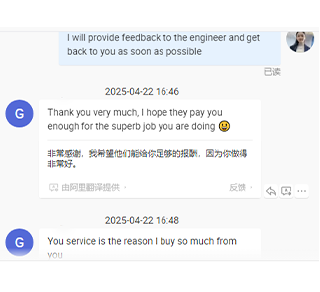

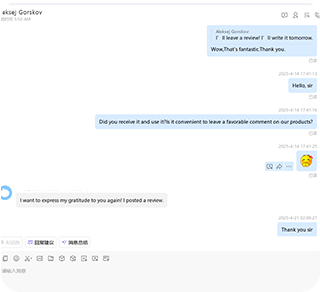
These snapshots illustrate real procurement & QC conversations (anonymized) covering MTR requests, heat‑treat confirmation and packing instructions.
Conversion actions — choose the next step
- Request Factory Pricing — get a landed price and MOQ for ground bar or forged blanks.
- Request Free Sample — we ship a sample shaft with inspection report for validation runs.
- Talk With Our Engineer — 30‑minute technical review focusing on heat treatment profile and balancing.
- Get Shipping Plan — container packing, rust prevention and customs paperwork tailored to destination port.