Guangdong Yingtai High Precision Technology Co., Ltd. — Your Trusted Partner for High-Quality CNC Electrical Discharge Machining (EDM) In highly competitive manufacturing landscapes, CNC Electrical Discharge Machining (EDM) remains an indispensable method for producing
Product Details
Precision CNC EDM Services for Industrial Manufacturing Excellence
Guangdong Yingtai High Precision Technology Co., Ltd. — Your Trusted Partner for High-Quality CNC Electrical Discharge Machining (EDM)
Understanding CNC EDM: Industry Context
In highly competitive manufacturing landscapes, CNC Electrical Discharge Machining (EDM) remains an indispensable method for producing complex, high-precision parts that traditional machining struggles to handle. From aerospace components with intricate cavities to medical instruments requiring micron-level tolerance, EDM’s unique capabilities deliver unmatched accuracy and surface finish.
CNC EDM operates by eroding metal using controlled electrical sparks, enabling it to cut extremely hard and electrically conductive materials with precision. However, selecting the right provider is non-trivial. Operational nuances such as electrode material selection, flushing methods, and parameter optimization directly influence final part quality and production lead times.
Procurement managers and manufacturing specialists recognize that outsourcing CNC EDM demands a partner with proven technical expertise, robust process control, and reliable repeatability. Especially for parts with demanding tolerance stacks, nuanced surface integrity requirements, or multi-stage EDM processes (such as roughing followed by fine finishing), choosing an experienced workshop is critical to avoid costly rework or delays.
Key considerations for EDM procurement include machine calibration accuracy, electrode inventory, cycle time efficiency, and systematic quality control aligned to ISO and CE standards.
According to recent industry analyses 【Grand View Research】, investment in precision machining equipment, including EDM, has steadily increased due to demand for high-tolerance manufacturing in electric vehicle batteries, renewable energy systems, and medical microdevices. This trend reinforces the need for robust CNC EDM capabilities with flexible production capacity.
Technical Deep Dive Into CNC EDM Process
CNC EDM differs substantially from conventional machining operations because it removes material by spark erosion instead of mechanical cutting forces. This method excels with materials of high hardness such as:
Tool steels (H13, D2)
Tungsten carbide
Titanium alloys
Inconel and other nickel-based superalloys
Hardened stainless steels
Wire EDM utilizes a continuously fed brass wire to slice through workpieces for intricate profiles, while Sinker EDM employs graphite or copper electrodes to form complex 3D cavities via controlled spark gaps.
CNC EDM Key Parameters Overview
Process Element
Optimal Operating Range
Impact on Quality/Speed
Pulse On-Time
10 – 150 µs
Longer pulses increase material removal but risk surface roughness
Sparking Gap
0.02 – 0.05 mm
Critical for tolerance precision and electrode wear rate
Dielectric Fluid Flushing
Variable pressure & flow
Removes debris, reduces short circuits, stabilizes cutting
Electrode Material
Graphite, Copper, Tungsten
Influences wear resistance and finish quality
Machine Accuracy
±1–3 microns
Determines final dimensional tolerances and repeatability
It’s important to note that electric spark parameters require tailoring per batch depending on metal conductivity, geometry complexity, and cycle efficiency needs. Machines equipped with advanced CNC control algorithms can adapt pulse power dynamically, reducing electrode wear and improving throughput.
Our workshop employs state-of-the-art AgieCharmilles and Mitsubishi EDM equipment supplemented by in-process measurement systems to guarantee consistent compliance with engineering drawings. ISO 9001 and CE certifications demonstrate our commitment to international quality protocols.
Applications and Benefits in Industrial Sectors
CNC EDM shines where design intricacies or material hardness render traditional methods impractical. Typical application fields include:
Aerospace & Defense: Hydraulic components, fuel system parts, and turbine blades featuring complex internal channels.
Medical Devices: Surgical instruments and microfluidic components demanding biocompatible surface finishes and tight geometric tolerances.
Automotive Industry: Precision molds for injection molding, gearbox parts, and engine components made with high-hardness alloys.
Consumer Goods: Durable plastic mold inserts and tooling for aesthetic and functional product parts.
Many operations report that partnering with a skilled EDM supplier reduces secondary machining or polishing by 30–50%, significantly cutting cycle times and production costs. Moreover, EDM parts often outperform milled counterparts in fatigue resistance and surface integrity because of the non-contact nature of the process.
Buyer Insight: When planning parts for EDM, work closely with your supplier to review design features such as sharp internal corners, slot widths, and electrode accessibility to optimize machining efficiency.
Strategic Buyer Guide on CNC EDM Services
Sourcing CNC EDM capability is a complex balancing act — quality, leadtime, cost, and supplier reliability all weigh heavily. Here are practical procurement tips to guide your decision making:
Verify Machine Portfolio: Ensure your chosen shop runs advanced CNC EDM machines with appropriate electrode feeders for your product scale.
Ask About Quality Systems: Request copies of process control documentation and certifications such as ISO 9001 and CE markings.
Understand Tooling and Electrode Management: Electrode wear impacts cost and timing; inquire if the supplier fabricates their own electrodes in-house.
Clarify Surface Finish Metrics: Specify Ra or Rz values upfront with detailed inspection reports.
Consider Lead Times and Capacity: Discuss batch size flexibility and how bottlenecks are managed during production peaks.
Check Packaging and Logistics: EDM components are often delicate — confirm protective packing standards to prevent damage during transit.
Request OEM/ODM Support: Partners who contribute design feedback or offer tooling modifications can accelerate your product development cycles.
Reliable communication is critical. Buyers often make the mistake of accepting vague project timelines. Confirming regular updates and onsite visits when possible greatly reduces uncertainty.
Pro Tip: Request an initial prototype run to validate process control prior to full production release.
Our Factory Strength and Certifications
Guangdong Yingtai High Precision Technology Co., Ltd., based in Dongguan’s industrial hub, boasts a 35,000-square-meter modern production campus equipped to handle complex CNC EDM projects across multiple industries. Our investments include:
20 precision hydraulic presses and 30+ mold processing sets – guaranteeing in-house tool and electrode fabrication
Our workflow uses an integrated Industry 4.0 management system to track each part through design, tooling, EDM machining, inspection, and packing. This end-to-end control minimizes variation risk and accelerates problem resolution.
We comply fully with ISO 9001 quality management, CE safety standards, and maintain strict environmental controls to support high-precision, low-defect outputs demanded by sectors like aerospace, healthcare, and electronics.
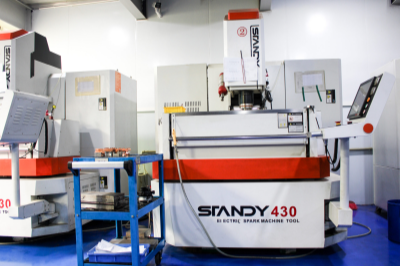
Yingtai’s advanced CNC EDM equipment in operation delivering close tolerance tooling.
Frequently Asked Questions
Q1: What materials can CNC EDM process reliably?
CNC EDM works on electrically conductive materials including hardened steel, titanium alloys, copper, tungsten, and exotic alloys used in aerospace and medical tooling. Non-conductive materials require alternative machining.
Q2: How do electrode materials affect EDM quality?
Graphite electrodes offer faster machining with good surface finish, while copper/tungsten variants provide lower wear for longer runs. Electrode choice balances machining speed and surface integrity.
Q3: What typical tolerances and surface finishes can be expected?
Depending on the machine and application, tolerances down to ±3 microns are achievable with surface finishes of Ra 0.1μm or better on fine EDM cuts.
Q4: Can your EDM services support high-volume production?
Yes. Our production scheduling and equipment scale enable batch runs ranging from prototypes to large-scale volumes with consistent quality and leadtime management.
Q5: What inspection methods confirm EDM quality?
We use coordinate measuring machines (CMM), surface profilometers, and digital microscopes to assess dimensional accuracy and surface condition. Certification reports are provided for every batch.
Customer Reviews & Procurement Scenarios
John Stevens – Procurement Manager, Aerospace Supply Firm
“Yingtai’s CNC EDM team handled a challenging titanium turbine blade mold with microns tolerance. The precision cut and turnaround exceeded expectations, reducing our usual secondary rework drastically. Their communication throughout the job was top-tier.”
Get in Touch
If you have any camping barbeque equipment inquiry, please feel free to contact us.